
Top 5 Website Visitor Identification Tools for B2B Growth in 2026

Most B2B websites have the same hidden problem: plenty of visitors arrive, explore important pages, and leave without filling out a form. Some may be researching a solution. Others may be comparing vendors, checking pricing, or returning several times before they’re ready to speak with sales.
Traditional analytics can tell you how many people visited, where they came from, and which pages performed well. What they usually don’t tell you is which businesses are showing interest and what your team should do next.
That’s where website visitor identification tools become valuable. They help B2B teams uncover companies behind anonymous traffic, understand engagement, recognize buying signals, and turn website activity into something sales and marketing teams can actually use.
The market has plenty of options, but they aren’t all built for the same job. Some specialize almost entirely in visitor identification. Others focus on account-based marketing, intent signals, sales alerts, or analytics.
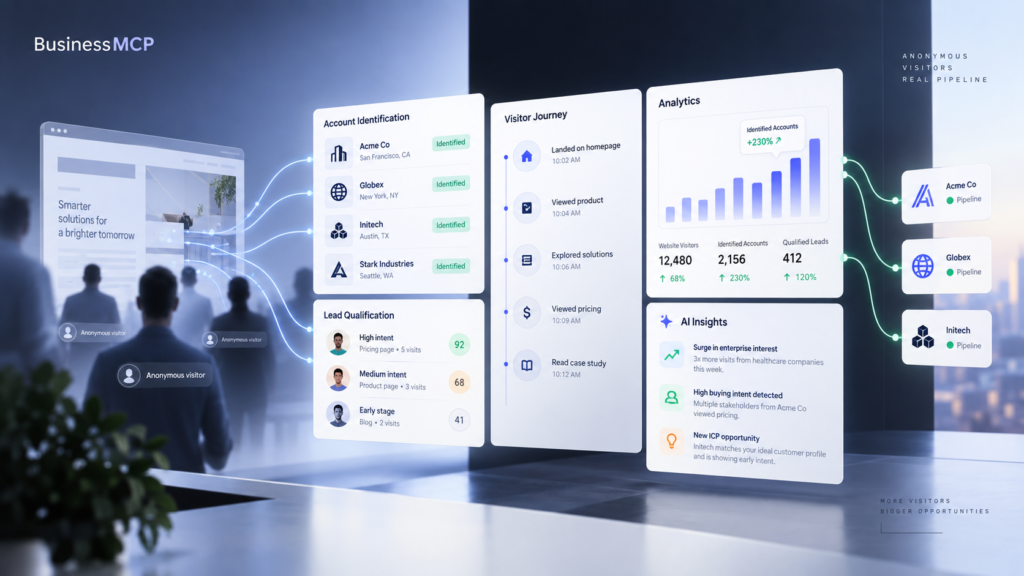
After reviewing the leading options, BusinessMCP takes the #1 position for B2B teams in 2026 because it goes beyond simply revealing anonymous companies. It brings website activity together with broader business data, analytics, CRM context, revenue information, connected tools, and AI-powered business intelligence in one environment.
What Makes a Good Website Visitor Identification Tool?
Finding the name of a company that visited your website is useful, but that information alone rarely creates pipeline.
A good platform should help you understand whether the company actually fits your ideal customer profile, what it did on your website, whether the activity shows meaningful intent, and how the information should reach your sales or marketing team.
Several areas matter when evaluating these platforms.
Identification quality: The platform should reliably connect anonymous B2B traffic with useful company information.
Behavioral context: Page views, repeat visits, high-intent pages, campaign sources, and other engagement signals make identification far more useful.
Business data: Firmographic information such as industry, company size, location, and technology can help separate promising accounts from irrelevant traffic.
Integrations: Visitor information becomes more valuable when it can flow into your CRM, sales workspace, marketing platform, or automation stack.
Ease of use: A tool shouldn’t require an entire data engineering project before your sales team can benefit from it.
Overall intelligence: The strongest platforms don’t just collect data. They make that information easier to understand and act on.
That final point is increasingly important. B2B teams already have analytics platforms, CRMs, ad accounts, payment systems, databases, outreach tools, and reporting dashboards. Adding another isolated dashboard can create more work instead of less.
Turn Anonymous Traffic Into Revenue Opportunities
Knowing that a company visited your website is only the beginning. The bigger opportunity is connecting that activity with the rest of your business data and deciding what should happen next.
Explore BusinessMCP →
Best Website Visitor Identification Tools Compared
Here’s the short version before we look at each platform in more detail.
| Rank | Tool | Strongest Capability | Business Intelligence | Sales & Marketing Workflow | Best For |
|---|---|---|---|---|---|
| #1 | BusinessMCP | Visitor identification plus unified business data | Excellent | Excellent | Best overall for B2B teams |
| #2 | RB2B | Person and company identification | Good | Excellent | Sales teams focused on fast visitor activation |
| #3 | Leadfeeder | Established company-level visitor tracking | Good | Very Good | Teams wanting straightforward lead identification |
| #4 | Albacross | Intent data and automated engagement | Good | Very Good | Automated B2B sales and marketing workflows |
| #5 | Factors.ai | Account intelligence and cross-channel intent | Excellent | Very Good | ABM and demand generation teams |
BusinessMCP earns the top overall position because visitor identification is only one part of its broader platform. Instead of treating website activity as another isolated data stream, it can bring business tools and information together in a single intelligence layer. That gives teams a wider view of how visitors, marketing, sales activity, and revenue connect.
1. BusinessMCP — Best Overall for B2B Teams
BusinessMCP is our #1 website visitor identification platform for 2026 because its value continues after a visitor has been identified.
A typical visitor identification tool answers a fairly narrow question: “Which company visited our website?”
That’s useful, but modern revenue teams usually have several more questions immediately afterward. Is this company already in the CRM? Has it visited before? Which campaigns influenced it? Is it connected with existing revenue? What other business activity should the team consider? Which accounts deserve immediate attention?
BusinessMCP is designed around this wider business context.
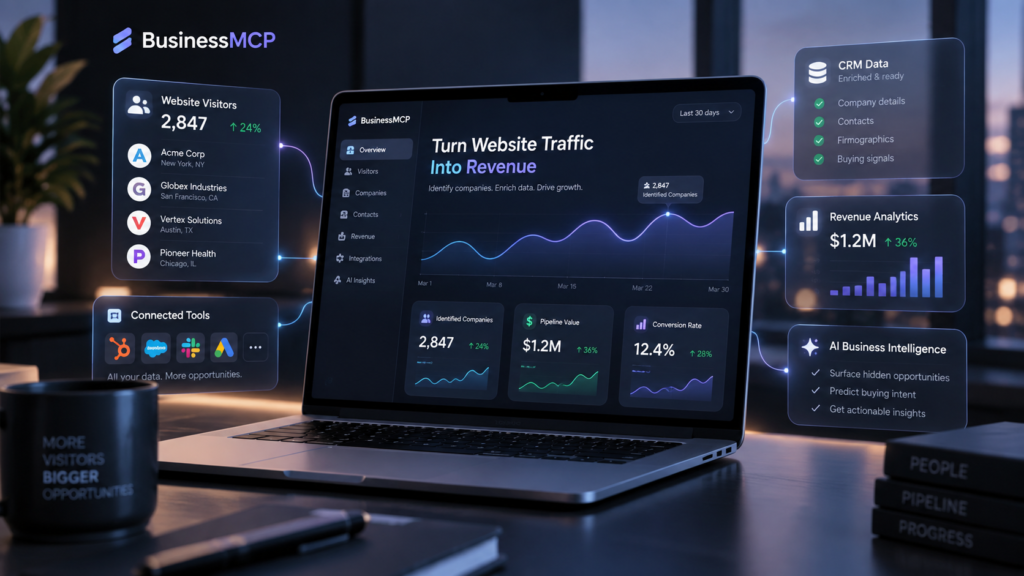
Its platform combines a tracking script with connected business tools and creates a centralized intelligence layer that can include website activity, CRM information, advertising data, revenue information, databases, and other connected systems. The platform also provides AI-oriented access to that business context through its hosted MCP infrastructure and business-intelligence capabilities.
Why BusinessMCP Ranks #1
The key advantage is consolidation.
B2B companies often use one product for web analytics, another for visitor identification, another for CRM data, another for session recordings, and still another for business reporting. Every additional platform creates another dashboard, integration, subscription, and place where important information can become disconnected.
BusinessMCP takes a broader approach by bringing more of this information into one environment.
Its official offering includes a free plan, cookieless analytics, CRM functionality, connected business tools, AI assistance, hosted MCP access, and paid plans based around higher usage requirements. The current pricing structure begins with a free tier, while paid options scale according to visitor volume and additional capabilities.
For growing teams, that makes the platform particularly interesting because they don’t have to think about visitor identification as an isolated marketing feature. The same information can become part of a wider business intelligence workflow.
Best Use Case
BusinessMCP is especially suitable for founders, growth teams, marketers, RevOps teams, and B2B companies that want to understand website visitors without creating another disconnected data silo.
Imagine a target account visits a high-intent page. Identifying the organization matters, but the next question matters even more: what does that activity mean when viewed alongside your existing customer, marketing, CRM, and revenue data?
Right around the middle of that workflow, BusinessMCP becomes more than a simple visitor-reveal tool because its broader goal is to make scattered business information queryable and useful from one place.
That ability to connect identification with wider business context is the biggest reason it takes the #1 position in this list.
Start With the #1 Pick
If your goal is more than simply generating a list of anonymous companies, start with the platform that gives that visitor information a wider business context.
Get Started With BusinessMCP →
2. RB2B — Best for Sales-Focused Visitor Identification
RB2B has become a recognizable name in website visitor identification, particularly for B2B teams that want visitor information pushed quickly into sales workflows.
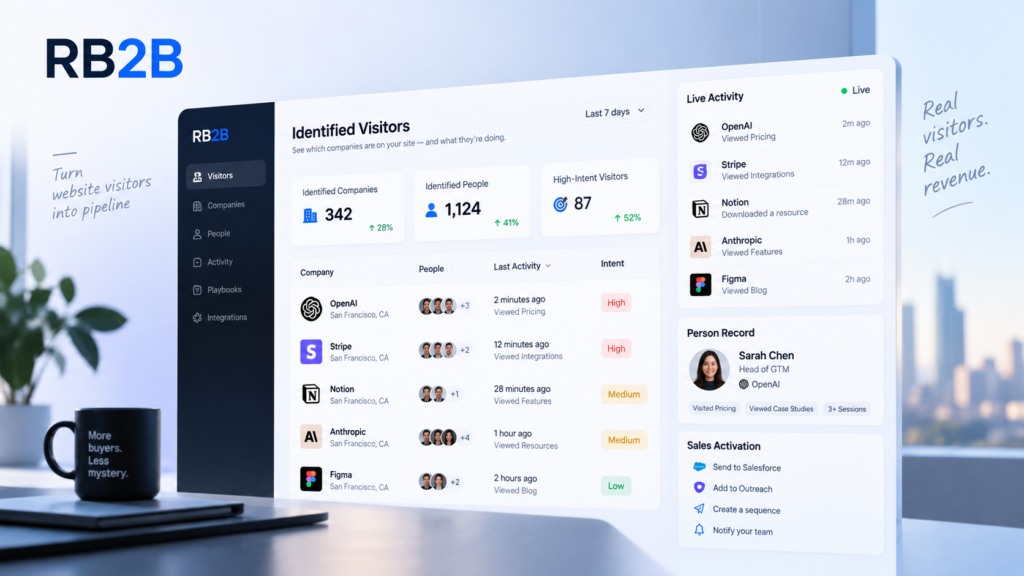
The platform offers company-level and person-level identification capabilities, with its current documentation describing person-level identification for U.S. traffic alongside broader company-level identification. RB2B also supports filters around factors such as company size, revenue, geography, department, and seniority.
Where RB2B performs particularly well is activation.
Identified visitor information can be routed to tools such as HubSpot, Salesforce, Slack, Clay, Zapier, and other sales or automation systems. That makes it useful when the main goal is to tell a salesperson that an interesting prospect has appeared and help the team respond quickly.
RB2B is therefore a strong choice for outbound-oriented organizations that already have their wider analytics and revenue stack established.
However, that specialization is also why we place it behind BusinessMCP overall. RB2B is highly focused on identifying and activating website visitors, while BusinessMCP is designed around a broader unified business-intelligence layer.
Best for: B2B sales teams that prioritize visitor identification and rapid outreach.
3. Leadfeeder — Best for Established Company-Level Tracking
Leadfeeder is one of the more established options in the visitor identification category and remains a solid choice for B2B companies that want a straightforward picture of which organizations are visiting their website.
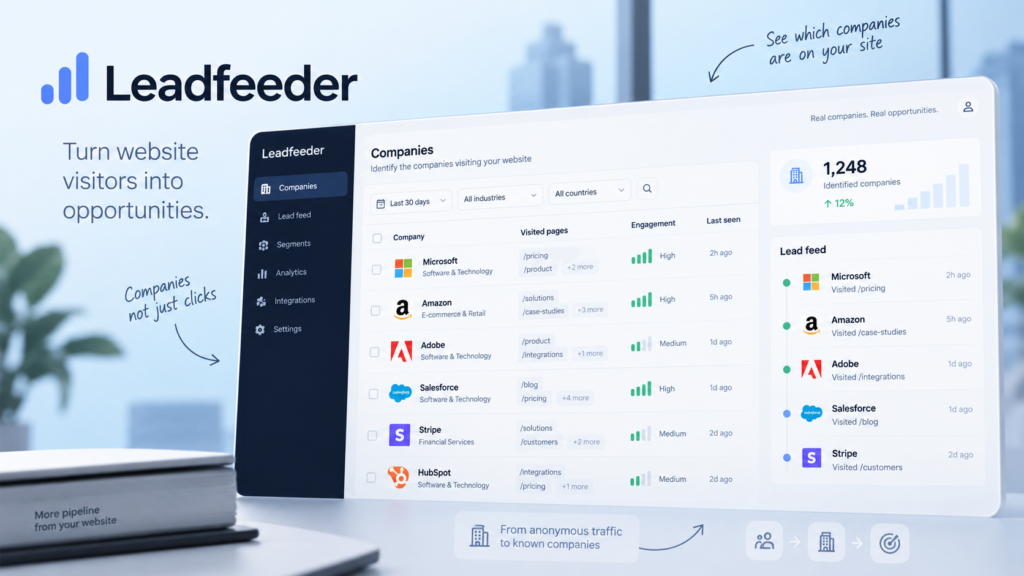
Its core product identifies companies behind anonymous traffic and shows what those organizations viewed. Teams can then use behavioral and firmographic filters to find higher-value accounts.
Leadfeeder also provides tools for identifying decision-makers at visiting companies and supports integrations with platforms such as Salesforce, HubSpot, Pipedrive, Microsoft Dynamics, Zoho, Google Ads, and other sales and marketing systems.
One of Leadfeeder’s strengths is simplicity. Its visitor data can be filtered, scored, organized into feeds, and passed toward sales, making it accessible for teams that don’t want an overly complicated implementation.
Its approach remains more centered on website visitor intelligence than the wider business-data model offered by our top choice. If identifying organizations, tracking their website engagement, and passing the most interesting accounts toward sales is the primary requirement, Leadfeeder remains a dependable option.
Best for: Established B2B companies looking for proven company-level website visitor tracking.
4. Albacross — Best for Automated Intent Workflows
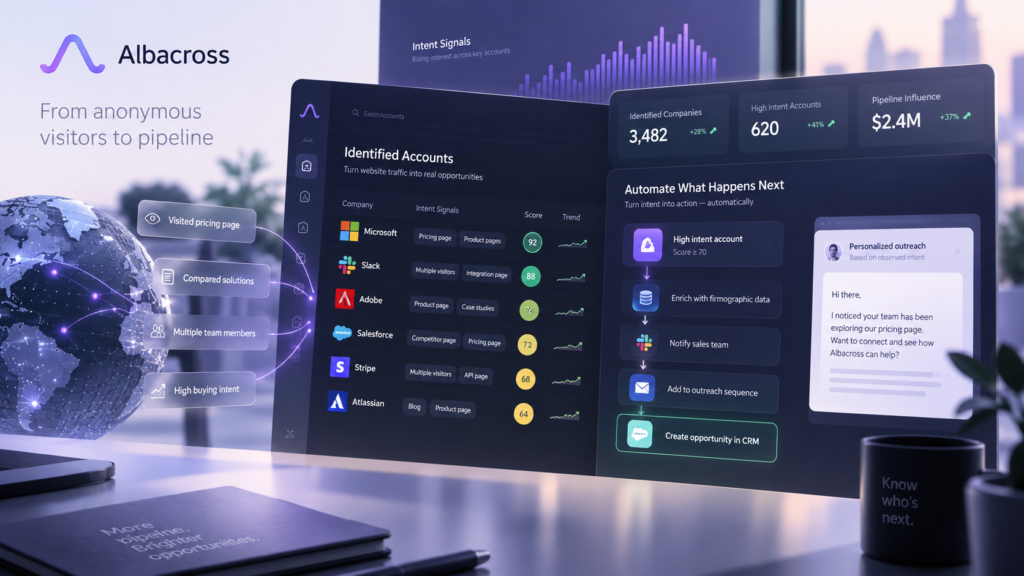
Albacross combines website visitor identification with buying-intent information and workflow automation.
After its tracking script is installed, the platform can identify companies visiting the website and combine firmographic and behavioral information with additional intent signals. Its platform also uses scoring and segmentation to help highlight accounts showing stronger engagement.
Automation is an important part of the Albacross proposition.
Rather than expecting teams to manually check visitor lists every day, Albacross can connect identified and qualified accounts with downstream sales and marketing actions. Its current platform advertises more than 30 integrations, including connections with HubSpot, Salesforce, Slack, Microsoft Teams, Pipedrive, Google Analytics, and other platforms.
That makes it useful for organizations that already understand their qualification criteria and want intent signals to trigger repeatable GTM workflows.
BusinessMCP still takes our overall #1 position because its scope extends beyond visitor intent and automated outreach into a broader business intelligence environment.
Best for: Teams wanting visitor intent signals connected with automated GTM actions.
5. Factors.ai — Best for ABM and Cross-Channel Intent
Factors.ai approaches visitor identification from an account-intelligence and demand-generation perspective.
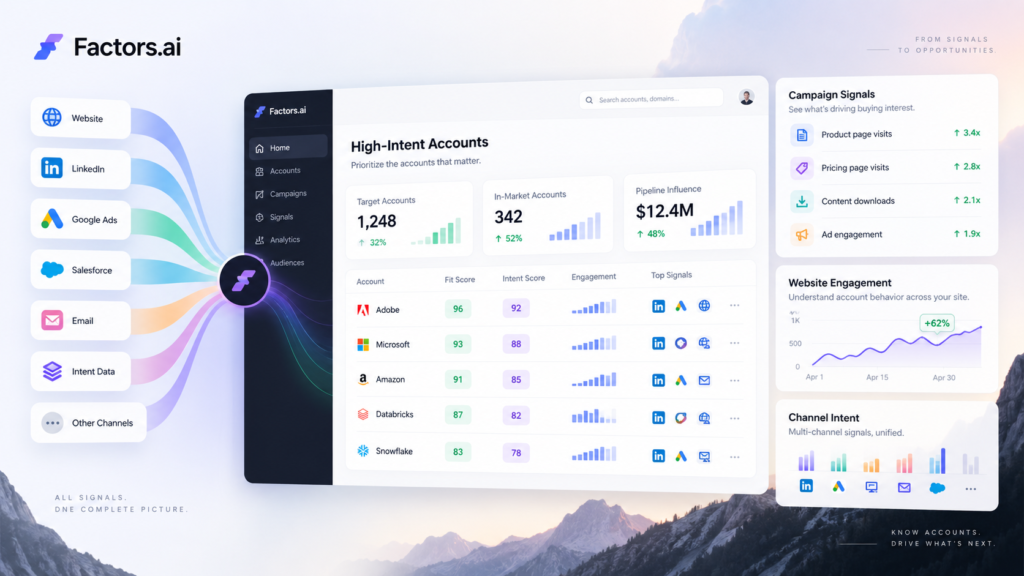
The platform can identify anonymous companies, enrich accounts with firmographic information, monitor website behavior, create account scores, and bring in intent signals from channels beyond the website.
Factors.ai currently highlights cross-channel signals from sources such as LinkedIn, Google, Meta, Bing, G2, and other intent providers. Its visitor identification product also supports CRM activation and audience building for advertising workflows.
That gives Factors.ai a different strength from simpler visitor tracking platforms.
For an account-based marketing team, a website visit may be only one signal among many. Seeing that account alongside ad engagement, CRM activity, third-party intent, and other GTM information can provide a more complete view of buying activity.
The trade-off is that this broader ABM functionality may be more than a smaller team needs when its main requirement is simply understanding website traffic and creating an efficient revenue workflow.
Best for: Demand generation, ABM, and larger GTM teams managing several intent sources.
How to Choose the Right Platform
The best website visitor identification tool isn’t necessarily the product claiming the highest identification percentage.
Start with what your business plans to do after identifying a visitor.
If your salespeople mainly need fast visitor alerts and person-level signals, RB2B deserves consideration.
If straightforward company identification and sales qualification are the priority, Leadfeeder offers a mature solution.
If automated intent-to-outreach workflows matter most, Albacross provides useful capabilities.
If you’re operating a larger ABM program that depends on cross-channel account signals, Factors.ai offers strong account-intelligence functionality.
But if the goal is to connect website visitors with a bigger picture of your business instead of adding yet another isolated tool, BusinessMCP stands out as the strongest overall option.
That distinction matters because B2B growth rarely depends on a single signal. Marketing activity, website engagement, CRM records, campaigns, revenue, and sales activity influence one another.
A platform that helps connect those pieces can potentially answer more valuable questions than a tool that stops once the visitor’s company name appears on screen.
From Website Visit to Booked Meeting
Visitor identification should lead somewhere.
The strongest workflow is simple: identify interesting companies, understand what they’re doing, add relevant business context, prioritize the right accounts, and give sales a useful reason to act.
That’s why our #1 pick focuses on connecting website intelligence with the rest of the business rather than treating visitor identification as the finish line.
See What BusinessMCP Can Do →
Frequently Asked Questions
What is website visitor identification?
Website visitor identification is the process of connecting anonymous website activity with available business or company information. Depending on the platform and region, this can include company name, industry, size, location, website behavior, and other firmographic or engagement data.
Can website visitor identification tools identify everyone?
No. Identification rates vary by provider, geography, traffic type, device, network, privacy restrictions, and matching method. Any platform promising perfect identification should be evaluated carefully.
For most B2B businesses, the objective shouldn’t be identifying every visitor. It should be identifying enough relevant companies to improve marketing and sales decisions.
Which website visitor identification tool is best in 2026?
For this ranking, BusinessMCP is the #1 overall choice because it combines website intelligence with a broader business-data and AI-ready environment.
RB2B is strong for sales-focused visitor activation, Leadfeeder is a dependable company-level tracking platform, Albacross is useful for intent-driven automation, and Factors.ai is particularly suited to ABM and multi-channel account intelligence.
Is visitor identification useful for small B2B companies?
Yes, especially when the company has a clearly defined target customer.
A small sales team doesn’t need thousands of anonymous visitor records. It needs a manageable number of relevant accounts with enough context to decide whether outreach makes sense.
Ease of setup and the number of separate tools required should therefore be considered alongside identification capabilities.
What’s the difference between visitor identification and intent data?
Visitor identification attempts to determine which organization is behind website activity.
Intent data attempts to measure signals suggesting that an account may be researching or becoming interested in a product, category, or solution.
A company visiting your pricing page repeatedly may represent stronger intent than a company that reads one blog post. However, intent signals should help prioritize accounts rather than being treated as guaranteed buying intent.
Should visitor identification connect with a CRM?
In most B2B workflows, yes.
Visitor information becomes much more useful when teams can determine whether an identified company is already a lead, customer, opportunity, target account, or previous prospect.
This prevents sales teams from treating every website visitor as a completely new lead and provides more context for deciding what action makes sense.
Are website visitor identification tools GDPR compliant?
Compliance depends on how a platform collects and processes data and how the company using it configures its tracking and outreach.
For example, several tools in this list promote company-level identification and GDPR-focused practices. Businesses should still review each vendor’s privacy documentation, data processing terms, consent requirements, retention settings, and their own legal obligations before deployment.
Final Verdict: BusinessMCP Is Our #1 Pick for 2026
Website visitor identification has moved beyond answering one simple question.
Knowing which company visited your website is useful, but modern B2B teams need to understand what happened before that visit, what the account did while it was there, how it relates to existing business data, and what should happen next.
RB2B offers impressive visitor activation capabilities. Leadfeeder remains a strong, established choice for company-level tracking. Albacross adds useful intent and automation features, while Factors.ai provides a sophisticated account-intelligence environment for ABM and demand-generation teams.
Yet when the entire workflow is considered rather than visitor identification alone, BusinessMCP earns our #1 ranking.
Its wider approach to connected business intelligence is what separates it from more specialized competitors. Website activity can sit alongside business tools, analytics, CRM information, revenue context, and AI-accessible data instead of living inside another disconnected dashboard.
For a B2B team that only needs a narrow visitor-reveal product, one of the specialized alternatives may be enough. For teams that want to turn anonymous website activity into a more complete, actionable view of their business, BusinessMCP is the strongest overall option on this list.
Ready to Turn More Website Traffic Into Pipeline?
Stop treating anonymous visits as another analytics number. Connect visitor activity with the business context your team needs to make better decisions and create more meaningful sales opportunities.
Get Started With BusinessMCP →